When putting together your snowboard, bindings might not be the first thing you think about, but they’re a critical part of your setup. Snowboard bindings are the crucial link between your boots and your board. The right pair can make a huge difference in your comfort, performance, and control on the mountain.

Whether you're just getting started or looking to upgrade your current gear, understanding how to choose snowboard bindings that match your riding style, ability level, and terrain preference is key. We’ll break down the main types of snowboard bindings, explain how flex plays a role, go through the different binding styles, and help you find the best match for your ride.

Types of Snowboard Bindings

Snowboard bindings come in different styles to match different types of riding. Some offer all-around performance for riders who like to explore the whole mountain, while others are built specifically for park laps, freestyle tricks, or powder-filled freeride lines. Choosing the right bindings starts with knowing where, and how, you like to ride.

All-Mountain
If you’re looking for a setup to take from the groomers, through tree runs, hit powder stashes, and even a few laps through the park, look for all-mountain snowboard bindings. These are the most versatile and most commonly used bindings. The perfect choice for riders who want one setup to do it all.
All-mountain bindings cover a wide range of ability levels, from beginners to experienced riders. Most choose a medium flex for all-mountain bindings since they offer a balance of support and flexibility for a variety of conditions and terrain. All-mountain bindings are an easy choice if you’re not ready to commit to a specific style or riding or want something that can adapt to changing conditions.

Park & Freestyle
For riders who love rails, jumps, and buttering all over the mountain, park or freestyle bindings are the way to go. They offer more maneuverability and flexibility, making it easy to hit jumps and tricks. Park and freestyle bindings usually have a soft to medium flex and work best for riders who are looking for more mobility and a playful feel.

Powder & Freeride
If you're chasing deep snow and steep lines, freeride or powder-focused bindings are designed with performance and power in mind. These are typically stiffer bindings resulting in more direct energy transfer for maximum response and control in technical terrain. They make a great choice for aggressive and experienced riders seeking out superior performance on big mountain lines, tight tree runs, and in endless powder.

Snowboard Binding Flex

Like snowboards and boots, snowboard bindings come in different flexes depending on the rider’s ability level, riding style, and personal preferences. Many snowboard brands rate their bindings on a scale of 1 to 10, with 1 being the softest flex and 10 the stiffest. 

Soft Flex (1 to 3): Great for beginners and freestyle riders, soft bindings are forgiving and easier to maneuver. They allow for a more playful ride and make it easier to butter, press, and tweak grabs.

Medium Flex (3 to 8): Ideal for all-mountain riders who want the best of both worlds—support and flexibility. Medium-flex bindings are the most versatile and suit a wide range of conditions and riding styles.

Stiff Flex (8 to 10): Best for advanced riders who like charging at high speeds or navigating steep terrain. These bindings offer precision and fast response, perfect for freeride and big-mountain snowboarding.

It’s also important to note that flex is dependent on your weight, riding style, and personal preferences. A heavier, more aggressive rider may like a stiffer binding for better response and performance, while a lighter beginner will benefit from a softer, more forgiving feel.
And remember when choosing your snowboard binding flex, you’ll want to consider your boot’s flex and size so you can choose the right flex and binding size that complements your current setup.

Back to Top

Snowboard Binding Styles

There are several snowboard binding styles to choose from, each with its own advantages depending on your preferences and riding style:
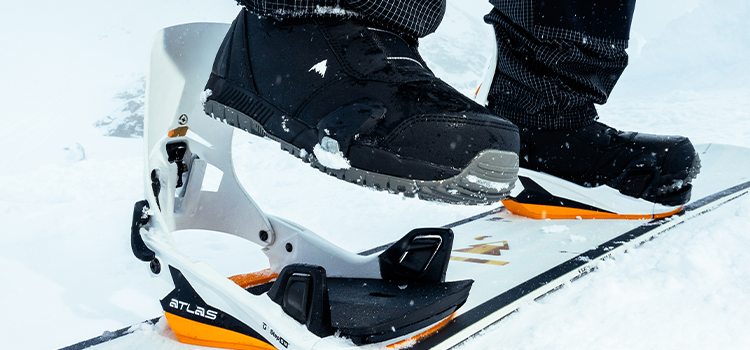
Union Atlas Step On Bindings

Traditional Strap Snowboard Bindings
Traditional strap bindings are the most common snowboard bindings. They feature two adjustable straps, one across the ankle and the other over the toe. This design offers reliable support, customizable fit, and a wide range of options across price points. Strap bindings are a solid choice for any rider, from beginners to pros.

Step On Bindings
Step On bindings have revolutionized convenience in snowboarding. Burton first introduced Step Ons during the 2017/2018 season, eliminating the need to bend down and strap in. With two points of contact on either side of the toes and one in the back to lock in the heel, the Step On binding requires no hands to click in and has a small lever on the side to exit. Step On bindings require Step On snowboard boots due to the unique technology. Since their release, Step On bindings have been highly popular due to their speed and simplicity without sacrificing responsiveness and performance.

Rear-Entry Bindings
Rear-entry offers a blend of control and support that traditional strap bindings have, plus the quick and easy use. They resemble traditional strap bindings, featuring straps that run along the ankle and toe. The difference is that the highback of rear-entry bindings hinges back, allowing you to slide your boots into the bindings. Rear-entry bindings are a convenient option, but some find them cumbersome to adjust and not provide as much support and performance as traditional strap bindings.
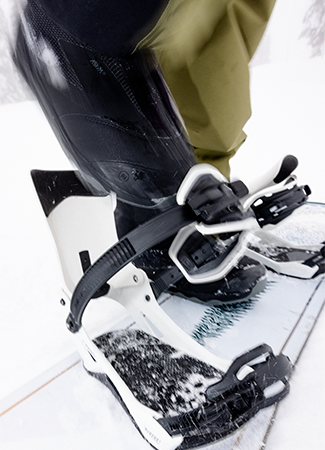
Fase Fast-Entry System

Hybrid Speed-Entry, Fast-Entry Bindings
Brands like Nidecker and Fase are leading the charge in reimagining traditional strap bindings technology with new hybrid, speed-entry, or fast-entry designs that improve ease of use without compromising performance.

Supermatic bindings by Nidecker, launched in 2022, to bring an automatic, speed-entry where the highback and straps open to create more space for boots to get in and out of without needing to loosen any straps. Once your boot is in the binding, the highback and straps lock in like a traditional binding, meaning less adjustment needed. You can find Supermatic tech on bindings from Salomon and Bent Metal.

New for the 2025/2026 season, Fase bindings were introduced as a lever-less option to fast-entry systems. The highback opens back so riders can easily get in and out of their bindings by simply adjusting the ankle Fast Strap, a quick solution for traditional strap bindings. 

Both Supermatic and Fase bindings are considered hybrid bindings since they can also function like traditional strap bindings, offering familiar performance and control. They're compatible with virtually any snowboard boot and board setup (with the exception of Step On boots), making them an easy upgrade without requiring a full gear overhaul. These innovative designs save you time on the mountain while delivering the performance riders expect.

Splitboard Bindings
Designed specifically for splitboards, these bindings let you hike uphill and ride downhill on the same setup. In tour mode, the bindings pivot at the toe to allow a natural stride. When you're ready to descend, they reconfigure into a traditional snowboard binding. Splitboard bindings are essential for backcountry riders seeking untouched snow and rugged terrain.

Back to Top

Binding to Board Compatibility

Before purchasing bindings, make sure they’re compatible with your board’s mounting system:

4x4
The 4x4 mounting pattern has pre-drilled holes to secure your bindings to. The 4x4 has two rows of screw holes, each spaced 4cm apart and requires four screws to secure each binding.4x4 boards usually have three holes per row, allowing different stance widths and configurations. This mounting pattern was widely recognized as the standard mounting pattern for years until it was replaced by the 2x4 pattern.

Burton Channel System with Burton Step On Genesis EST Bindings

2x4
The 2x4 mounting pattern is the most popular configuration you’ll find on most boards today. Like the 4x4 pattern, the 2x4 has two rows of screw holes. In each row, the holes are spaced 2cm apart, usually with 6 screw holes per row. This allows for more stance options than the previous 4x4 pattern, allowing riders to fine-tune their stance.

Burton 3D
The Burton 3D mounting system is Burton’s unique spin on traditional mounting patterns. Instead of rows, Burton 3D pattern uses a triangular layout with just three screws. You can still find some boards with Burton’s 3D pattern, but this mounting position was later replaced by Burton’s Channel system, which is now the standard on all Burton boards.

Burton’s Channel System
The Burton Channel system is Burton's most innovative and modern approach to snowboard binding mounts. First introduced in 2007, The Channel system replaces traditional hole patterns with two long slots—one for each binding. This design was created to make setup faster, cleaner, and far more adjustable. Unlike the older screw-based systems that limit stance options and require multiple screws per binding, the Channel system uses just two screws per binding and lets you dial in your stance with nearly unlimited precision.

Burton EST Bindings
With the creation of the Burton Channel system came the Burton EST bindings. Burton EST bindings work exclusively with The Channel. EST bindings use two screws to attach to the board, moving the mounting hardware from under the foot to either side of the binding. This change-up eliminates the dead spot traditional binding’s base plates create and allows for a more consistent flex throughout the board.

It’s important to note that with the Burton Channel system, you need to have the proper hardware. All of Burton’s Re:Flex and EST bindings are compatible with The Channel. Traditional bindings from other brands are also compatible with The Channel system, but require compatible baseplates. Most come with universal baseplates that work with The Channel, but if they don’t, you can usually purchase compatible baseplates separately.

Back to Top

Choosing the right snowboard bindings is about more than just looks or price. It’s about creating a setup that matches your riding style, skill level, and comfort preferences. From flex ratings and binding styles to mounting compatibility, every detail makes a difference in how your board feels and performs.

The best snowboard bindings help you ride longer, feel more confident, and get more out of every day on the mountain. So take your time, know your options, and find the pair that fits both your gear and your goals.